
Searching the Boulder Court Docket
Your strongest search key is the citation or city case number. The official Boulder Municipal Court page is the first stop for city matters. The court docket there ties into payment services for eligible cases. Paying a fine is not the same as viewing the full docket, though. Need the case file, the setting, or the current status? Ask the Boulder municipal clerk directly.
- Read the court name on the citation. Confirm that it says Boulder Municipal Court and is marked Municipal.
- Keep the citation or case number, the name used on the case, and the printed appearance or response date close at hand.
- Use the Boulder city court channel for an eligible payment, or call the tickets line at 303-441-4212 to confirm the municipal setting.
- Ask Boulder Municipal Court for the city record when a payment screen does not show the information needed.
- If the notice names County Court or District Court, switch to the Boulder-filtered state docket and the Combined Court clerk.
You can also reach Boulder Municipal Court by phone. Call 303-441-1841 for main or administrative questions, or 303-441-1840 for the Violations Bureau and warrant line. If you have a lawyer, confirm your Boulder setting with that attorney too.
Boulder Citation Names the Docket
The caption on your paperwork decides which docket you search. A yellow-backed summons marked Municipal belongs on the Boulder city docket. A citation captioned County Court goes to the state trial-court docket instead, often in class T. Sharing one street address does not merge the two clerks, their files, or their search tools.
Quick check: Read the court name and response line before using a portal. The issuing agency and caption identify the right Boulder docket.
Who wrote the ticket matters. Boulder police can issue a city matter. Colorado State Patrol, the sheriff, or another agency can issue a state-law case. The spot where the incident happened does not pick the city portal for you. Is the caption hard to read? Call the number printed on the citation. You can also call the Boulder municipal clerk before the deadline passes.
Boulder Municipal Court Basics
Boulder Municipal Court handles charter and ordinance violations for the city. Its docket covers city traffic, parking, photo-enforcement, animal cases, and municipal criminal matters. The city lists Presiding Judge Jeff H. Cahn as presiding. State felonies, private civil suits, domestic relations, and probate stay elsewhere. Other District Court or County Court work never becomes a Boulder municipal case.
Need to visit? The Boulder city court sits at 1777 Sixth Street, Boulder, CO 80302. Mail goes to P.O. Box 8015, Boulder, CO 80306-8015. Weekday hours run 8 a.m. to 4:30 p.m. There is one exception: staff close the counter from 8 a.m. to 1 p.m. on the third Friday. Closures change, so check the city page before you travel.
The official Boulder municipal page documents the court's services and contact channels.
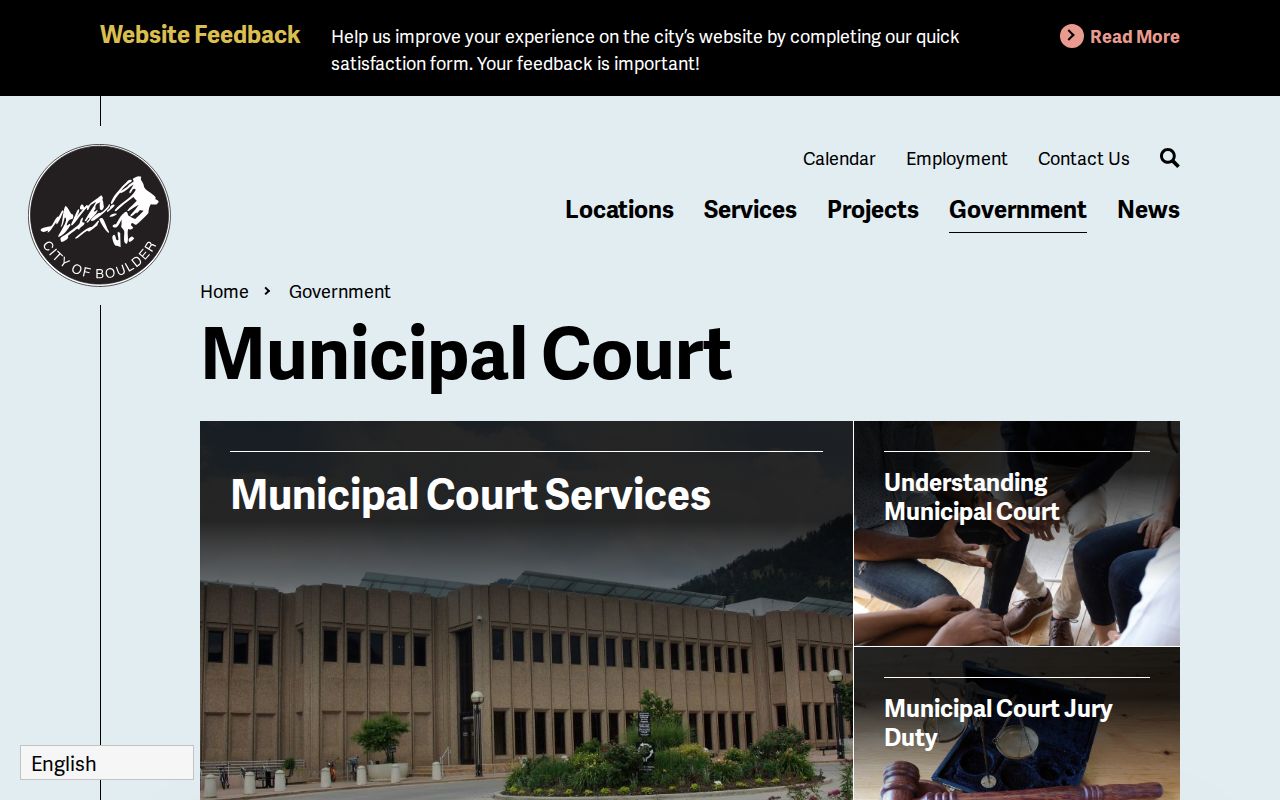
This is the channel for a Boulder ordinance violation or a city-issued citation. It is not the place for a County Court case.
Two Boulder Dockets One Building
Boulder Municipal Court and the Boulder County Combined Court both list 1777 Sixth Street. They remain separate offices with separate files. The city clerk keeps Boulder ordinance and city-ticket records, while the Clerk of Court for the Boulder County Combined Court keeps the state District Court and County Court records.
| Boulder Court | Docket Scope | First Contact |
|---|---|---|
| Municipal Court | City charter, ordinance, parking, photo enforcement, and city tickets | 303-441-1841 or the city court page |
| Combined Court | State felony, misdemeanor, traffic, civil, domestic, probate, and other state classes | 303-441-3750 or the Judicial Branch docket |
The old county courthouse at 1325 Pearl Street is not the usual state-court counter. For any Boulder court record, match the office to the case caption before you request anything. That single step keeps you out of the wrong system and away from the wrong clerk.
Court Dates and Settings in Boulder
Where do you confirm a Boulder municipal date? Use the summons. The newest city court notice also works, and so does the municipal clerk. Being eligible to pay does not mean no appearance is needed. Many traffic matters can be paid only under one condition: the summons lists a Pay and Close Amount. Most municipal criminal matters require you to appear.
| Date | The Boulder appearance or response date printed on the summons or later court notice. |
|---|---|
| Time | The start time assigned by Boulder Municipal Court; confirm changes with the clerk. |
| Courtroom | The room or location stated by the city court for the proceeding. |
| Judge | The judicial officer assigned to the Boulder municipal matter. |
| Setting Type | The city event, such as an appearance, hearing, trial, or compliance setting. |
A reset just moves the setting. It is not a dismissal. Asking for more time does not change your Boulder date until the court grants it, so keep the newest notice and call 303-441-1841 if two sources conflict.
Confirming a Boulder Municipal Setting
Start with the printed Boulder summons or the most recent court notice. Then call the municipal office. The tickets line handles citation routing. The main line covers general court administration. A warrant question belongs with the Violations Bureau rather than a payment screen. For help in person, go to the Boulder Municipal Court counter during posted city hours. You can also mail your request to P.O. Box 8015. The clerk offers no free city ROA portal in place of these channels. A city payment page can show whether an eligible amount is available. It is not the Boulder case history, though.
What if the notice names the Combined Court instead? Then use the state docket, call 303-441-3750, or contact Records/Research at 720-664-1468. Keep that state step brief, since it involves a different Boulder clerk.
Traffic Tickets in Boulder
Got a ticket under Boulder city law? That citation stays with Municipal Court. Read the summons closely. It shows either a Pay and Close Amount or a required court date. Paying counts as your plea and disposition as the city describes it. Anyone planning to contest should not pay first.
The counter accepts cash, check, money order, Visa, and Mastercard. The city also links CitePayUSA for eligible online payments. If no online amount appears, the case may be mandatory, unposted, or flagged for clerk review. Call before the response date instead of guessing. Parking and photo-enforcement matters use the same city channels. State-law tickets belong to County Court, though. The full split among issuers and custodians appears on the Boulder County traffic tickets page.
Boulder Payment Is Not a Docket
A Boulder payment that goes through resolves the eligible matter as the court rules provide. It is still not a docket. No downloadable ROA comes with it. The payment channel was built to accept funds. It was not built to display each filing, minute order, hearing, and final case event.
Boulder lists separate items that can apply in different cases: court cost, failure-to-appear, warrant, sealing, deferred prosecution, traffic deferral, OJW reporting, and default reporting. Never roll those into one assumed total. The clerk and the current case record determine what actually applies.
- Pay and Close
- A summons option allowing payment when the Boulder citation expressly provides it.
- Setting
- A scheduled Boulder court event that still requires attention unless the court changes it.
- ROA
- The chronological Register of Action, which is broader than a payment status.
- FTA
- Failure to appear, a case event that can lead to added court action.
Note: A Boulder payment receipt proves only the transaction. The official case events and disposition live in the city court file.
Where Boulder Cases Go
Boulder Municipal Court is a limited city court. A Boulder ordinance charge begins there. It stays there, unless an appeal or other authorized transfer creates a new proceeding. State-law misdemeanors and traffic citations land in County Court instead. Felonies are different. So are major civil, domestic, probate, and juvenile matters, which are filed at the state level in District Court.
Docket flow: Boulder Municipal Court › Boulder County Courts › District Court (Twentieth Judicial District)
Treat the arrows as a routing aid only. They make no claim that every Boulder municipal case passes through all three layers. An appeal follows Colorado's statutory municipal route. It creates court activity beyond the city file. When a caption names a state court, turn to the Boulder County court docket overview.
Requesting a Boulder City Court File
Municipal case files come straight from Boulder Municipal Court. Have the citation or case number ready. Also give the party name and the type of item you need. A clear request helps the city clerk separate a setting confirmation from a request for copies or research.
The Boulder municipal fee inventory lists a combined copies, fax, or research line of $5, along with other case-specific charges. Confirm the current amount and scope before ordering. A clerk-authenticated record may involve a different process than an informal status check.
County Court and District Court files are another matter. Never send those requests to the city. Use the state's Record/Document Request Form or email 20recordsrequest@judicial.state.co.us. That state route covers an ROA, pleading, order, or other Combined Court document, not a Boulder municipal file.
Boulder Court Record Access Rules
Boulder municipal records are requested from the city court that holds them. Public access has limits. Juvenile material, sealed or suppressed cases, adoption records, and protected personal data can be withheld or restricted under the law and a court order.
Key rules:
Chief Justice Directive 05-01 governs access to Colorado state court records and helps explain why a state file uses a different route.
Colorado Supreme Court Chapter 38 rules set Judicial Branch standards for public information and records.
Colorado Open Records Act applies to qualifying government records, while judicial case files follow court access rules.
A blank public search proves nothing about Boulder. It doesn't mean a case never existed or was sealed. Ask the correct clerk what can lawfully be confirmed, and bring government photo identification if protected access is involved.
When Boulder Docket Search Is Empty
Start with the number and the court caption. A Boulder city case can be missing from a payment page because it is not eligible, has not posted, or requires an appearance. Call the municipal tickets line. Keep the printed deadline in view.
Then test the court split. A state-law citation may sit in the Colorado docket under Boulder County, County Court, and class T, while a felony may use CR. Civil, domestic, and probate matters use other state classes. When the full state number is known, search by the complete year, class, and sequence.
Access limits come last. Juvenile and sealed material will not behave like a public adult docket. The Boulder city clerk can disclose only what law and the court allow. Absence from a payment screen or date search does not settle the question.