
Searching the Erie Court Docket
The official Erie Municipal Court page and the paper citation are your two starting points. A Town ordinance charge stays in municipal court. So does one under the Erie-adopted Model Traffic Code. A state-law charge belongs to a county judicial district instead. Resist the urge to pick Boulder County. The citation may just show an Erie mailing address.
- Read the court caption, issuing agency, charge source, case or citation number, and response date.
- For an Erie Town case, use the official Town portal or contact the Erie municipal clerk.
- Confirm the date, setting type, and in-person requirement with Town Court before appearing.
- For a state case, identify whether Boulder or Weld is the proper county from the citation.
- Request the case record from the court that owns it rather than relying on a payment status screen.
Erie Town cases never appear as complete records in the Colorado state docket. The split runs both ways, since state cases do not fold into the Erie municipal file either. Keeping those layers separate is the quickest route to the right clerk and setting.
sentences
short
Erie Two-County Docket Trap
Erie sits in two counties at once. Most of it falls inside Boulder County, and the rest spills into Weld. The 2020 Decennial Census put the town's whole population at 30,038, though that figure counts the entire place rather than just the Boulder side. The same split governs where a case lands. A state charge tied to Erie can land in either county's court docket, while a Town ordinance case always stays with Erie Municipal Court, no matter which side of the line the address sits on.
Population tells you nothing about jurisdiction. The official 2020 Census place query backs the town's total. But a head count is not a jurisdiction map. Look at the citation caption instead. The issuing agency and the court address are the clues. They actually tell you which docket holds the case. An empty Boulder County docket search does not mean the record is sealed. Pause before guessing. First ask whether the matter is municipal. Then ask whether the state citation points to Weld rather than Boulder. If the caption still leaves you unsure, call the Erie clerk and sort it out.
Erie Municipal Court Basics
Erie Municipal Court meets at Town Hall, 645 Holbrook Street, Erie, CO 80516. Mail goes to P.O. Box 750, Erie, CO 80516. Doors are open weekdays from 8 a.m. to 5 p.m. The court's phone is 303-926-2851. Email goes to emc@erieco.gov. Judge Amanda Bailhache took the bench on April 9, 2025. This court handles Town ordinances. It also handles the version of the Model Traffic Code Erie has adopted and amended. Anything charged under state law, criminal or traffic, belongs in county court instead. Plan on showing up in person; Erie proceedings are presumptively face to face. The Town also posts court schedules. Its rules for live-streaming adult criminal and traffic proceedings are posted too, along with maximum-penalty information. Watching a live stream never excuses a party from appearing.
Erie Municipal Court
Town Hall, 645 Holbrook Street
P.O. Box 750
Erie, CO 80516
303-926-2851
emc@erieco.gov
Weekdays, 8 a.m. to 5 p.m.
Erie Town Portal Limits
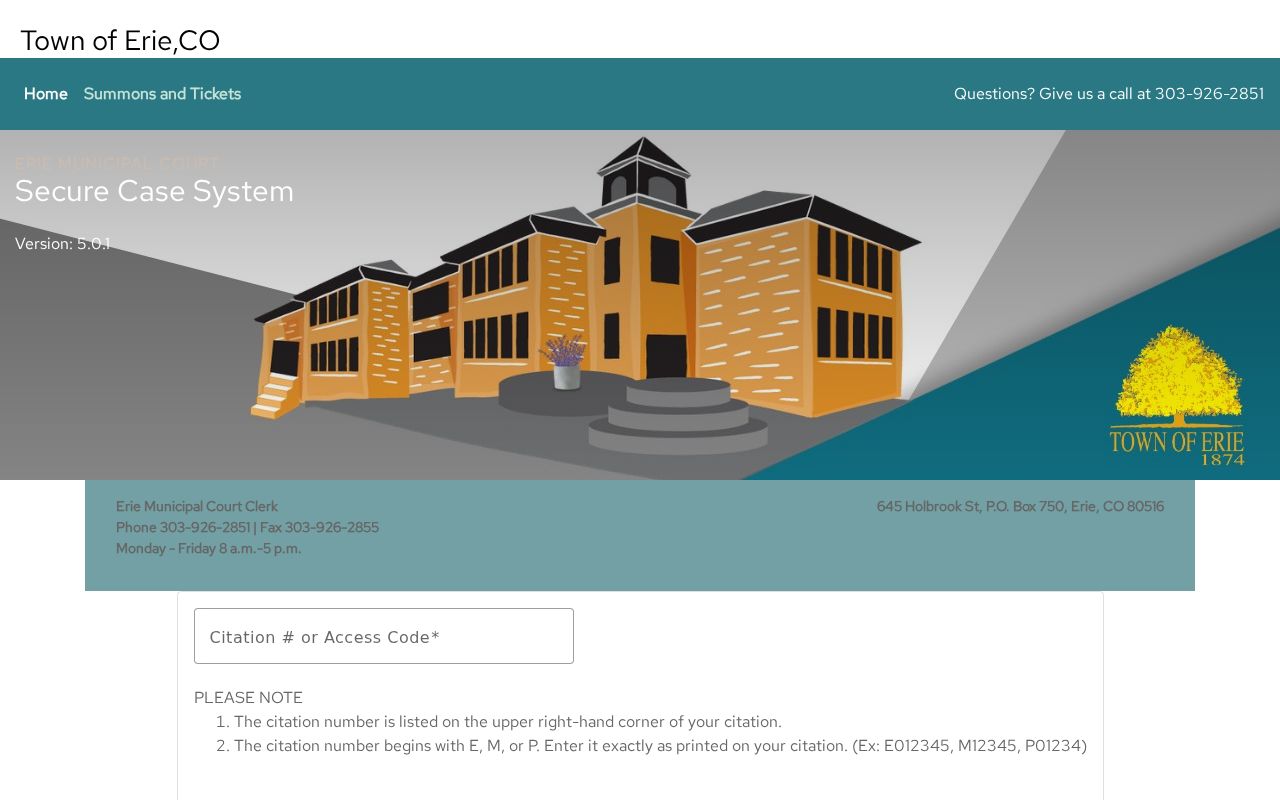
Erie's official payment page hands you off to the Town Court portal. Enter the exact citation details the screen asks for, and resist the urge to guess at a format. Remember what the portal covers: Town cases only. It is not a Boulder or Weld County case search, and it does not substitute for a full Register of Action.
The official Erie Court portal page itself lays out the fields a searcher must supply.
The town portal handles one job: payments. It will not show the charge history, a setting, a written motion, an order, or whether a warrant is active. For those parts of an Erie court docket, call Erie Municipal Court and ask for the exact record by name.
Portal limit: A payment balance can help identify an Erie Town citation, but it cannot establish the full docket or final case status.
Court Dates and Settings in Erie
Erie posts its municipal schedules. But your citation and any notice from the clerk control what happens in your case. Plan on appearing in person. Before the hearing date, check the charge, the date, the start time, and any court notice that arrived later. One caution: the Town has a live-streaming order for adult criminal and traffic proceedings. That order alone does not permit remote attendance.
| Date | The summons date or later Erie court setting. |
|---|---|
| Time | The listed start time for the specific municipal matter. |
| Location | Town Hall unless Erie Municipal Court directs otherwise. |
| Appearance mode | Presumptively in person; viewing access is not appearance authority. |
| Setting type | Response, hearing, trial, payment review, or another court-ordered event. |
A reset only moves an event. The Erie court docket keeps the case. Every continuance or other change takes court action, so a scheduling conflict between the portal and a later notice is worth a call to 303-926-2851 or an email to emc@erieco.gov.
Erie In-Person Court Schedule
Here is the key local practice: Erie proceedings are presumed to be in person. The Town's order allows a public stream of an adult Erie criminal or traffic proceeding. That stream lets people observe. Watching online is not attendance, though. A defendant, witness, or attorney cannot substitute it for required appearance. Read the current Erie schedule together with any case notice.
If the date seems off, lay the citation beside any mailed or emailed notice. Then compare it with the published schedule. Next, ask the clerk to confirm the active setting. Say which document you hold. Say whether the case number belongs to Town Court. That one detail keeps staff from answering for a state case held in Boulder or Weld.
Note: Erie's public viewing rules never override a case-specific order. Such an order can require a person to appear at Town Hall.
Traffic Tickets in Erie
Erie Municipal Court handles traffic cases under the Town's adopted Model Traffic Code, as amended. Where your ticket goes depends on who wrote it. A Town citation stays with the Erie portal and clerk. A state citation belongs in county court. So read the court name printed on the ticket before you act. No camera-adjudication program for Erie appears in any current Town or citation channel. So treat those official sources as the reliable ones.
Before you pay anything, understand what payment means. In most traffic courts, paying counts as a guilty plea and closes the case. If you want to fight the ticket, meet the response date. Or meet the appearance date on the citation. A plea deal, a driving course, or a deferred judgment all depend on eligibility. A judge decides each one. Nothing is automatic. Hardship requests go before the judge at a payment-review date. The payment portal alone will not handle them.
An active warrant is a clerk question. Call the Erie clerk directly. Missing a court date can bring added orders, costs, a warrant, or collections. The offense determines which. Only the court itself can tell you the current status of an Erie traffic docket.
Erie Payment Channel Comparison
Erie lists four ways to pay. They are online, by mail, in person, and through a secure drop box at Town Hall. Never put cash in the drop box. Any of these channels gets your money to the court. But none of them is a full Erie municipal record search. Keep proof of how and when you paid. Then confirm the posting whenever your case has a deadline or an active setting coming up.
| Channel | Use | Important limit |
|---|---|---|
| Online | Eligible Erie Town payment | Portal status is not a full docket |
| Send payment under current court instructions | Allow for delivery and verify the deadline | |
| In person | Pay through the Town Hall counter | Use listed business hours |
| Secure drop box | Leave an allowed noncash payment | Never deposit cash |
Hardship review does not start with a partial online payment. That payment creates no hearing by itself. Contact the clerk to get a payment-review date. Then follow the judge's process. A contested ticket also demands the formal court response described on the citation. That response lives on the citation itself.
Where Erie Cases Go
A Town ordinance or municipal traffic case starts in Erie Municipal Court. It stays there unless an appeal moves it up. State-law charges go to the judicial district for the county named on the citation. Erie's geography settles nothing. Boulder County does not automatically hold the record. Weld may be the right state-court route instead.
Docket flow: Erie Municipal Court › Correct County Court › District Court
Think of the Erie flow as a jurisdiction map. It is not a promise that every case passes through all three courts. For a Boulder state case, the free Boulder-filtered Colorado Docket Search shows settings. The Combined Court clerk supplies the ROA and documents. For an Erie Town case, stay with the Erie municipal clerk. For a Weld state case, follow the county named on the citation.
Erie Citation Chooses the County
A street address does not pick the court. The citation caption and the charge do. "Erie Municipal Court" signals a Town case. A Colorado state court caption points to a county and its judicial district. The issuing agency also helps separate a Town enforcement action from a state-law citation.
- Town ordinance
- A local Erie rule heard by Municipal Court.
- Model Traffic Code
- The traffic code Erie adopts and amends for Town enforcement.
- State charge
- A Colorado law matter assigned to the proper county court system.
- Register of Action
- The chronological state-case summary held through the relevant state court, not the Erie pay portal.
When a docket search comes up empty, check your facts before trying another database. A Boulder search can fail because the case is municipal or sits in Weld. An Erie portal search can fail because the case is actually a state matter. The clerk named on the paper is your best first call.
Erie Court Record Access Rules
Erie Municipal Court keeps the records for Town cases. Public access does not put every protected detail online, though. Ask the Erie clerk for the city case record, and bring the citation or case number, a party name, and enough detail to identify the matter. A state court file belongs with its county clerk instead. Court rules can also seal, shield, or restrict juvenile and protected material.
Access boundaries:
CJD 05-01 governs access, exclusions, and remote access for Colorado Judicial Branch court records.
Colorado Open Records Act provides a general public-record framework, while a judicial case file follows the proper court custodian.
Colorado Supreme Court Rules, Chapter 38 addresses Judicial Branch information and administrative records.
For the municipal channel, email emc@erieco.gov, call 303-926-2851, mail P.O. Box 750, or visit Town Hall. Staff can tell you the current submission requirements when you request a record. For a Boulder County state file, the Combined Court gives you an online request form, a Records/Research email and phone, mail, and counters in Boulder and Longmont.
Erie Written Motion Channels
Erie requires motions and attorney entries in writing. The Town takes them by web form, mail, email, or in person. A phone call can clarify the procedure, but it is never the filing itself. This local rule makes the line between asking a question and formally placing a request before the court matter quite a bit.
- Use the Town web form when the current court page routes the filing there.
- Mail written material to P.O. Box 750, Erie, CO 80516.
- Email the municipal court at emc@erieco.gov when that method fits the filing instructions.
- Deliver written material at the Town Hall counter during listed weekday hours.
Keep a copy and proof of submission for anything you file. A filed motion is a request, not a ruling. Relief is not granted until an order says so. Check the Erie court docket or the clerk's response for the resulting order and any changed setting. Active-warrant questions go to the clerk, since sending a motion neither removes a warrant nor cancels court.