
Searching the Lafayette Court Docket
Start at the Lafayette Municipal Court page. Before you pick a way to search, gather the basics from your paperwork: the court name, where the charge came from, any response date, and the citation or case number. That single detail decides everything. When the charge cites the Lafayette Municipal Code or a city-issued ticket, the municipal clerk keeps the case. A state statute charge is different. Even if the event happened inside Lafayette, a Colorado state court, not the city, holds that docket.
For a city matter, follow this order:
- Check that the document names Lafayette Municipal Court and copy the full citation or case number.
- Open the city’s eligible-citation search and enter the exact number before trying broader identifying details.
- Read the summons date and any prosecutor offer before deciding whether payment is appropriate.
- Call or email the Lafayette clerk when no online result appears or when an appearance is required.
- Use the state docket and Combined Court channels only when the charge is a state or county matter.
Paying online gets you a receipt, not a full Lafayette court docket. The screen will confirm an eligible citation and the amount owed, and that is all. For the case record itself, the setting, any order, and the current status, go to the Lafayette municipal clerk.
Lafayette Citation Search Keys
The citation number is your best search key. No two city tickets share one. It pulls the right Lafayette case fast. The official Lafayette citation portal covers eligible municipal matters only. Check that your citation names Lafayette Municipal Court before you use it. One more caution: this portal is not the Colorado Judicial Branch Docket Search. A missing result there does not mean your case vanished.
| Clue | What it answers | Next channel |
|---|---|---|
| Citation or case number | Identifies the city matter most precisely | Lafayette portal or clerk |
| Defendant name and date of birth | Helps the clerk distinguish similar names | Record request |
| Printed court name | Separates city from state jurisdiction | Named court |
| Response or summons date | Shows the deadline or planned setting | Clerk confirmation |
The manifest image below comes from the Lafayette municipal payment search.
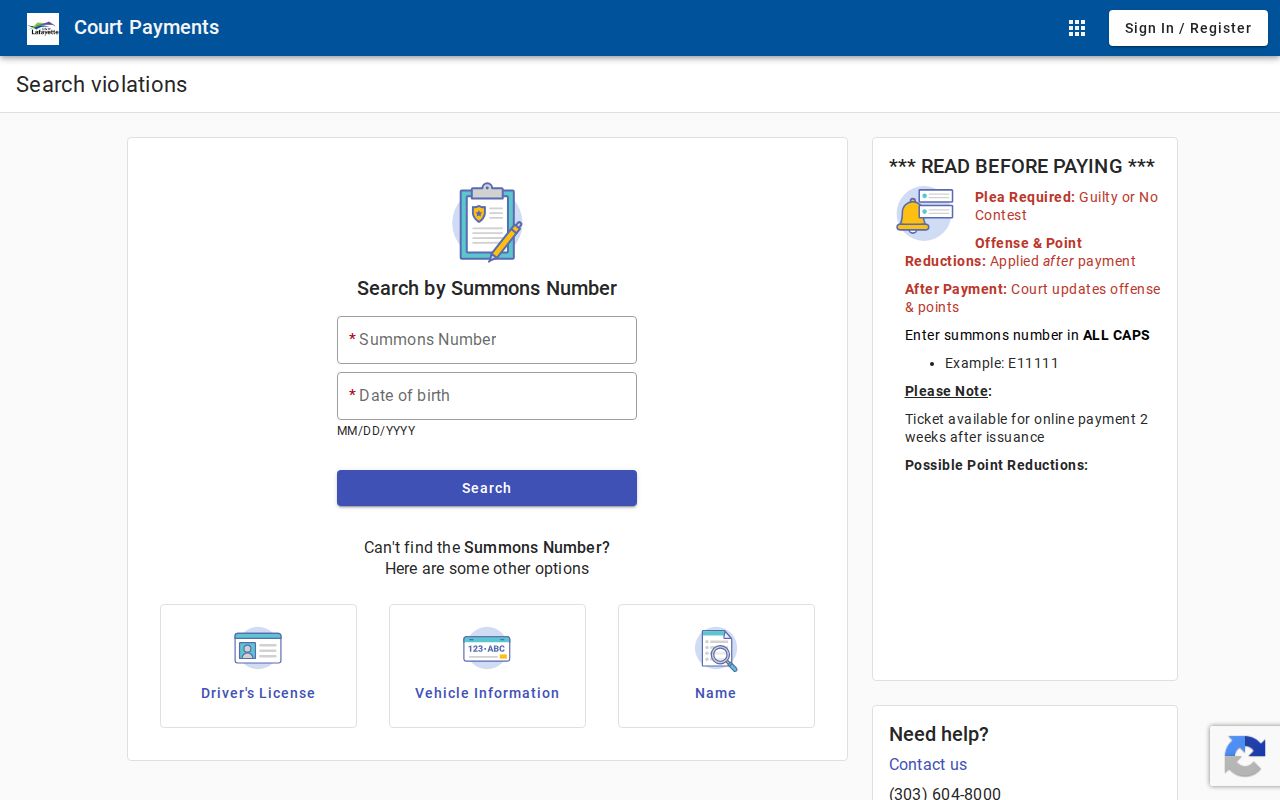
The portal's narrow job tells you what it can and cannot do. It finds an eligible citation for payment; the Lafayette clerk holds the actual municipal court record.
Lafayette Municipal Court Basics
You will find Lafayette Municipal Court at 451 N. 111th Street, Lafayette, CO 80026. Call 303-604-8000 or email municipalcourts@lafayetteco.gov. Weekday hours run 8 a.m. to 5 p.m. Judge Amanda Bailhache presides, with Administrator Genevieve Rotella and Clerk Emily Collier, and the court usually sits in person three times a month.
What does this court hear? Lafayette cases cover Municipal Code traffic and parking tickets, animal and code matters, and city petty or misdemeanor offenses. State felonies belong elsewhere. So do private civil suits, domestic cases, and probate files, which the Lafayette court does not take. Remote attendance is not automatic either. If you want it, ask Lafayette for approval, because an email or an online payment screen never counts as permission to skip showing up in person.
Lafayette Municipal Court
451 N. 111th Street
Lafayette, CO 80026
303-604-8000
municipalcourts@lafayetteco.gov
Weekdays, 8 a.m. to 5 p.m.
Lafayette Court-of-Record Status
Lafayette Municipal Court is a court of record. Its proceedings create a paper trail that can support an appeal. That label carries real weight. An appeal does not restart the case as a fresh city hearing. Under Colorado law, the municipal record instead moves into the District Court review path. Keep that distinction in mind when reading a docket summary. The summary alone is not the full record of what happened below.
- Municipal ordinance
- A local rule enacted by Lafayette and heard in the city court.
- State statute
- A Colorado law handled in the state court system, not merely because the event occurred in Lafayette.
- Court of record
- A court whose preserved proceeding supports appellate review on the record.
- Register of Action
- The chronological summary used for state cases; Lafayette city records remain with the municipal clerk.
Check the caption on your citation to tell the systems apart. A city ordinance charge belongs in Lafayette. A state class such as T, M, or CR points to County or District Court. Sort them correctly. That way a failed state docket search will not hide a valid Lafayette municipal record from you.
Court Dates and Settings in Lafayette
Lafayette holds court three times a month, and the sessions are usually in person. For any municipal setting, the summons date comes first. Confirm it with the Lafayette clerk. Do so if the case does not appear online, if a remote request is still pending, or if a prosecutor offer changes how you plan to plead. One call to 303-604-8000 settles the procedure. Remember, though, the clerk confirms dates but grants nothing. A continuance or remote attendance requires its own request.
| Date | The summons or clerk-confirmed municipal court date. |
|---|---|
| Time | The time printed for the Lafayette appearance or later setting. |
| Location | Lafayette Municipal Court unless the court approves another mode. |
| Appearance mode | Normally in person; remote participation needs request and approval. |
| Setting type | Plea, in-court disposition, bench trial, jury trial, or another ordered event. |
A reset only moves a date. The Lafayette court docket entry still stands until the court itself acts. A continuance takes court action, not a message left with staff, so trust the newest Lafayette notice or clerk confirmation whenever an old date and a later instruction disagree.
Lafayette Court Sits Three Times Monthly
Lafayette holds court only three times a month. That makes a missed or misunderstood date matter more. It matters more here than on a daily calendar. It also means the Lafayette payment screen is a poor way to guess the next session. The current summons and the municipal clerk control the real date. Lafayette court schedules can shift. Joining remotely still requires approval. If a Lafayette setting looks wrong, check four sources. These are the printed summons, any later written notice, the eligible-citation portal, and the clerk's current response. Ask what the setting is for. It could be a plea, a trial, or another event. Then ask whether you must appear in person. Keep the answer with your case paper. A city clerk can explain procedure but cannot give legal advice. Note: Lafayette's normal session pattern does not replace the date and appearance terms printed for a specific municipal case.
Traffic Tickets in Lafayette
A ticket written under Lafayette's Municipal Code belongs to Municipal Court. Use the eligible-citation portal when your number matches. Before the court date, a prosecutor's early offer can sometimes cut the points. Accepting and paying that offer ends the case. But it is case-specific. No Lafayette traffic docket promises one. Read how the plea works before you pay. Payment can resolve the case the way the court describes. Want to fight it? Follow the response or summons date and reach the court before the deadline. Never pay first if you plan to contest. Lafayette lists a 25 percent community-justice surcharge plus $10 for victim services. Court costs vary. They run $10 for a plea by mail, $30 for an in-court guilty plea, $40 for a bench trial, and $45 for a jury trial. What you owe depends on the case and the order. One more thing. A state-law ticket stays state even when an officer writes it in Lafayette. State patrol, sheriff, and similar citations usually land in County Court under the T class. For that county-wide split, see Boulder County traffic ticket records.
Lafayette Pay-or-Contest Record Effects
Pay or fight. Each path writes something different into the Lafayette court docket. An eligible payment records the plea, the outcome, and the effect the court describes. A contest request keeps the case moving toward a hearing. Miss the deadline, though, and added Lafayette court consequences can follow. The city lists a $50 default fee, a $50 Outstanding Judgment Warrant fee, and $75 in warrant fees. Ask the clerk which apply to your case.
| Choice | Reader action | Likely docket effect |
|---|---|---|
| Accept eligible offer | Read terms and pay before the stated cutoff | Plea, disposition, and payment post |
| Contest | Respond or appear by the printed date | Hearing or trial path remains active |
| Request another mode | Seek court approval before the setting | Order or approved appearance instruction controls |
| Miss the deadline | Contact the clerk at once | Default, OJW, warrant, or added cost may exist |
The portal is not the docket. A card charge that goes through does not mean the Lafayette case is complete, and a dead payment button does not mean a warrant. For the true status, confirm with the Lafayette municipal clerk.
Where Lafayette Cases Go
Not every Lafayette case belongs to the city. Ordinance violations and city tickets stay in Municipal Court unless an appeal lifts them out. State misdemeanors, state traffic, felonies, private civil suits, domestic relations, and probate all move to Colorado courts. County Court takes misdemeanors, traffic, limited civil, small claims, protection orders, and preliminary felony matters. District Court gets the felonies plus the larger, specialized cases.
Docket flow: Lafayette Municipal Court › Boulder County Courts › District Court
Treat the Lafayette flow as a routing aid. It is not a promise that each case touches every court. The caption tells you where to start. For a Lafayette state case, the free Boulder-filtered Docket Search lists scheduled events. Need the official ROA or documents? The Boulder County Combined Court clerk provides them. Reach that clerk through the record request form, 20recordsrequest@judicial.state.co.us, 720-664-1468, mail, or a Boulder or Longmont counter.
Lafayette Municipal Appeal Record
Lafayette Municipal Court is a court of record. That matters for appeals. A Lafayette appeal moves to District Court on the municipal record through the governing route. It does not quietly merge into a County Court T or M file. A notice, an assembled Lafayette record, and the appellate proceeding mark the shift. What happened in Municipal Court still lives in the original Lafayette court docket.
Before any appeal deadline, ask for the municipal materials. They should identify the judgment and the preserved record. The payment page will not carry them. The Lafayette clerk holds the city file and current procedure. Once the case sits in District Court, use the state court number. Use that clerk's channel instead. The Boulder County case lookup walks through the state search fields without repeating the city process.
Lafayette Court Record Access Rules
Lafayette municipal case records sit with the Lafayette court clerk. Public access has limits, though. The clerk may demand enough identifying data to find the case, and may withhold or redact anything a statute, rule, or court order protects. For state courts, Colorado Judicial Branch CJD 05-01 governs the records. Municipal custodians follow the rules and law that fit their own Lafayette files.
Access boundaries:
CJD 05-01 governs access to Colorado Judicial Branch court records, exclusions, and remote access.
Colorado Open Records Act supplies the general public-record framework, but court case access follows the correct judicial or municipal custodian.
Colorado Supreme Court Rules, Chapter 38 addresses Judicial Branch information and administrative records.
Keep the two systems straight. A state calendar result is not a Lafayette municipal file. A city payment record is not the state ROA. Ask the Lafayette clerk for city material, the Combined Court clerk for state material. That way each request lands with the office able to certify or lawfully release it.
Lafayette Record Request Fields
Lafayette's official record-request form wants the defendant, date of birth, and case or citation number. Complete identifying details go in as well. Those fields stop wrong matches. Name the record you need rather than asking for "everything." A citation history, a setting confirmation, an order, and a certified copy each take different work and fees.
The city lists its charges plainly. Pages run $0.25 each, and color pages are $0.75. A USB device costs $5. Certification adds $5, and research or retrieval runs $33.58 per hour. A $65 sealing fee appears too. Paying it does not guarantee sealing is available or granted. Eligibility and any order depend on the case.
File through whatever municipal channel the court identifies. Email municipalcourts@lafayetteco.gov or call 303-604-8000. You can also visit the counter at 451 N. 111th Street during listed hours when the form calls for direct handling. A state file goes the other way. Use the Combined Court's online form, email, phone, mail, or counter instead of sending it to Lafayette.