
Boulder County Court Calendars Explained
For state cases, the Colorado Judicial Branch Docket Search filtered for Boulder County is the free public calendar. It covers settings in the District Court of the Twentieth Judicial District. It also covers the co-located County Court. Filters let you narrow by county, courthouse, court type, division, date, case details, party, or attorney. The tool works well for a quick date check or a daily docket list. Still, it stops short of a full Register of Action, or ROA. It also will not open filed documents.
Boulder County court dates may sit at the Boulder County Combined Court or its Longmont site. Each result card names the courtroom and building. Municipal ordinance cases and city-issued tickets stay out of this state docket. That holds even though the city lies in Boulder County. Those dates belong to the municipal court that issued the ticket. So when a name search comes up empty, the case may simply be sitting in a city court.
Boulder Court Dates Are Not ROAs
A calendar entry tells you when and where something is set. An ROA tells you what has actually happened, in order. The court's record request form describes an ROA as a short case account. It can include charges, sentences, and minute orders. Because of that history, an older Boulder County court date can still appear in the ROA. That holds true even after the judge resets it to a new day.
Calendar or case history? Use the free docket for the next setting. Request the ROA or newest order when the sequence of events matters.
This split also explains why a hearing card may leave out claims, charges, lawyers, finances, the outcome, and document links. None of that makes the card wrong. It just reflects the card's narrow calendar job. When you need the filing history, move from the date result to the Boulder County case lookup process and then ask the clerk for the official record.
Finding Your Court Date
Pick the channel that fits the court and what you already know. The online search is quick. Yet the Clerk of Court, Boulder County Combined Court stays the authoritative contact. Compare anything you find against new minute orders or notices in the case. And ask your lawyer if you have one.
- Open the Boulder-filtered official docket. Select Boulder County, the Boulder or Longmont courthouse if known, and County, District, or Both.
- Choose a date range and at least one more filter. A full year, case class, and sequence is more precise than a common party name.
- Read the newest result for the date, start time, duration, hearing type, location, courtroom, and appearance mode. Print or export the list if a paper copy will help.
- For a doubtful or missing date, call Records/Research at 720-664-1468, the main clerk at 303-441-3750, or the Longmont court at 720-564-2522. The current division contacts appear on the judges and staff page.
- Ask at the clerk counter at 1777 Sixth Street in Boulder or 1035 Kimbark Street in Longmont. A written request may also go to P.O. Box 4249, Boulder, CO 80306.
- Use the issuing city court for a municipal matter. If represented, confirm the final instruction with the attorney handling the case.
No official Boulder source promises a public lobby terminal with deeper detail than the web tool. So call first before making the trip for that alone. Court staff can confirm procedure and settings, though they cannot give legal advice.
Boulder County Civil Return Dates
County civil return dates in Boulder County follow a set local pattern. Boulder settings land on Wednesdays at 1:30 p.m. Longmont settings fall on Fridays at 1:30 p.m. There are breaks for holidays and the Friday after Thanksgiving. The pattern helps you decode a summons. But the date printed on your case notice or a current docket result always wins.
Where you show up matters just as much. The Boulder County Justice Center at 1777 Sixth Street is the usual state-court site in Boulder. The historic county courthouse at 1325 Pearl Street holds county offices. It is not the normal state-court filing counter. A 1:30 p.m. weekday jail courtroom assignment means the Boulder County Jail at 3200 Airport Road. That is not a Justice Center room.
Longmont keeps its own combined-court counter at 1035 Kimbark Street. That counter closes at noon and reopens at 1 p.m. Let the result card or summons decide which building you use.
How to Read a Court Setting
A Boulder County court setting card bundles several details at once. Read the whole card instead of stopping at the date. The calendar does not reliably list the judge, so the courtroom, the location, and the current division assignment often do more to confirm your hearing than anything else.
| Date | The scheduled day for this event, which should be checked against the newest notice or order. |
|---|---|
| Time | The event start time, listed separately from its estimated duration. |
| Courtroom | The room tied to the setting; verify it again near the appearance date. |
| Judge | Not reliably shown in observed results; use the current division and staff directory when needed. |
| Setting Type | The kind of event, such as Jury Trial, Status Conference, Hearing, or Return Date on Summons. |
| Appearance | IN PERSON, VIRTUAL, or blank. A blank field does not grant remote attendance. |
| Location | The Boulder, Longmont, or other authorized site associated with the event. |
The case number and party name help you tell similar entries apart on a Boulder County docket. The result also lists estimated duration and hearing type. What it does not give you is the full caption, case history, claims, charges, or document images.
Boulder Court Date Labels
Every entry on a Boulder County court docket carries an event label. That label tells you what the clerk scheduled for that date. It does not tell you how things turned out once the hearing ended. Several common labels look similar. So read them closely before assuming what happened.
- Status Conference
- A proceeding used to review the case posture and identify next steps.
- Return Date
- An initial response or appearance date often shown on a summons calendar.
- Disposition Hearing
- A setting related to case disposition; its presence alone does not prove the result.
- Court Trial
- A trial heard by the court rather than a jury.
- Permanent Restraining Order Hearing
- A hearing on whether longer-term protection-order relief should enter.
You may also see several other labels on a Boulder County court docket. These include Jury Trial, Hearing, Initial Conference Appearance, Hearing on Guardianship, Motion to Modify Hearing, and Hearing on Citation. Each setting calls for different preparation. So ask the division or your lawyer what yours requires.
Remember that a label only describes the planned event. The ruling and the final status of the case live elsewhere in the docket. They are not in the label itself.
Continuances, Resets, and Cancellations
A reset simply moves a scheduled event. A continuance goes further: it is the court's permission to postpone. Neither happens just because someone asked, called the clerk, or reached an agreement. Only the judge can grant one. The newest order or notice, not an older calendar entry, is what controls.
Why might an old date still linger? The chronological ROA records case history. So a superseded setting can stay there even after the future calendar shows only the new event. When a prior notice conflicts with a current docket search, compare both. If the change just happened, call the assigned division or the clerk. Do not trust a screen capture or saved printout.
Annual rotation schedules tell you which Boulder County divisions carry certain dockets. They do not promise any one case will be heard on every listed date. Always check the individual case setting.
Boulder Virtual Court Date Checks
The calendar may mark an appearance IN PERSON or VIRTUAL. It may leave the field blank. A blank does not mean a Webex appearance is allowed. Remote access comes only from the court's instruction for that particular setting.
Start at the Boulder County trial-court hub. From there, reach the local virtual-courtroom directory and match your authorized division. Check the link against the calendar result or the case notice before logging on. A link listed for a division never changes an in-person command.
The same caution applies when a hearing changes format. A later court notice beats an old saved result every time. When in doubt, call the division. That one call settles whether the hearing is remote, in person, or moved to a new date.
Boulder Court Date Text Reminders
Colorado offers optional text reminders. They cover upcoming or missed dates and unplanned court closures in CR, T, M, and JD case classes. Enrollment runs through JDF 18, one case at a time. Mail the form or drop it at the Boulder or Longmont clerk counter.
Treat the reminder as an aid, not a new court order. Keep the latest filed notice and check the official calendar too. A changed phone number or a service delay can limit what a text alert tells you. The same goes for a case class outside the covered set.
Need a printed work list? The docket tool offers Export Results and Printable Version. Results appear twenty per page. Review each page before treating any export as a complete daily list.
If You Miss a Court Setting
Act promptly after a missed Boulder County setting. Check the official docket for a later event, review the newest case notice, and reach out to the assigned division, the clerk, or counsel. Never assume a new date was set. And the case is not over simply because the old event dropped out of a future-date search.
Missed a setting? A missed date can have serious case-specific consequences, so contact the court division or your lawyer without delay.
Ask what the court entered and whether a new appearance has been set.
Legal advice about the response must come from a licensed attorney, not court staff.
When the public calendar leaves you guessing, use the official Record/Document Request Form. It lets you ask for the ROA or a minute order from the Boulder County case. State court records staff also take requests by email at 20recordsrequest@judicial.state.co.us. A city-court matter goes through that municipal clerk instead, not the county courthouse.
The Judicial Branch posts court data and statistics on its official data and reports page. That page sits behind the court-system image that follows.
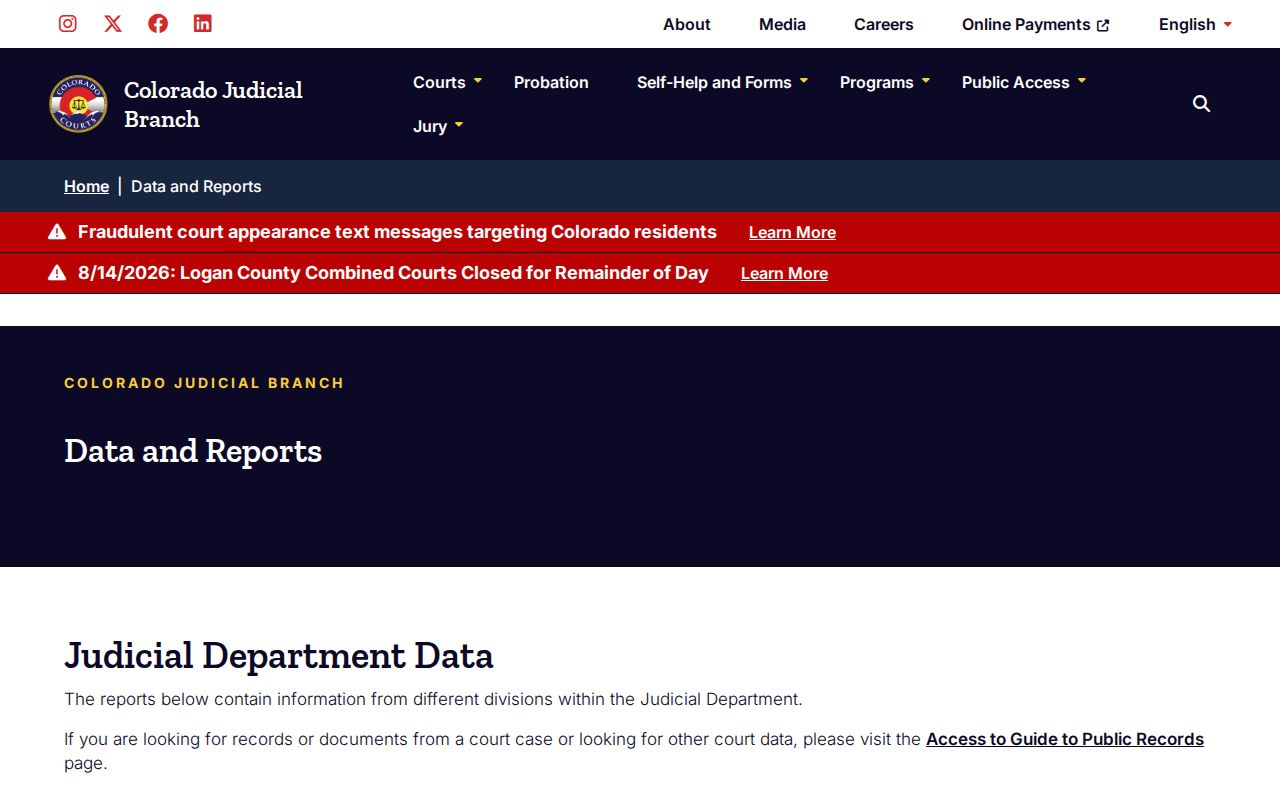
One missed setting matters. The state system publishes court information, but the current case notice and the clerk remain the sources to trust for an up-to-date Boulder County court date.