
Getting Boulder County Court Records
The Clerk of Court for the Boulder County Combined Court is the place to start for District Court and County Court case files. Requests go out several ways. You can submit the Colorado Judicial Branch Record/Document Request Form, email 20recordsrequest@judicial.state.co.us, call Records/Research at 720-664-1468, or mail P.O. Box 4249, Boulder, CO 80306. Walk-ins work too. The Boulder counter sits in the Boulder County Justice Center, 1777 Sixth Street, and the Longmont counter is at 1035 Kimbark Street.
Need only a court date or case number? The free Boulder-filtered Docket Search is a good first stop, but it is not a document repository. Colorado names contracted services that supply real-time ROA data. Vendor data is not the official court record, though, and it never includes copies of filed documents. For the court-issued ROA, pleadings, orders, judgments, or authentication, the clerk is still the source.
- Identify the court, case number, party name, and filing year as closely as possible.
- Decide whether the needed item is a calendar result, ROA, filed paper, judgment, or transcript.
- Choose the online form, email, telephone, mail, Boulder counter, or Longmont counter.
- List each document and mark certification or exemplification only when needed.
- Review the clerk's estimate, follow its payment directions, and supply identification if protected access requires it.
Boulder County Court Record Layers
One Boulder County court records search can point to four different things. The calendar tells you when and where a hearing is set. The ROA gives the dated history of filings, minute orders, settings, charges, sentences, or judgments. A filed paper is the real complaint, motion, order, or judgment itself. A certified or exemplified copy adds the clerk's authentication to the reproduction.
Knowing the difference prevents a common mistake. A calendar result does not prove that no other events exist. A vendor ROA will not hand you the signed order. When an exact filing matters, name that document in the request. Do not ask only for "the docket."
| Record layer | Best source | What it answers |
|---|---|---|
| Scheduled docket | Judicial Branch Docket Search | Current hearing date, time, place, and setting type |
| Register of Action | Combined Court clerk | Chronological case activity and minute entries |
| Filed document | Combined Court clerk | The actual pleading, order, judgment, or ticket |
| Authenticated copy | Combined Court clerk | A certified or exemplified reproduction |
Note: Municipal-code and city-ticket files stay with the municipal clerk. That holds true even when a city court shares a general location with state courts.
Court Record Types
Boulder County court records span several case classes in a single state clerk system. District Court files hold felony, unlimited civil, domestic-relations, juvenile, probate, and mental-health matters. County Court covers misdemeanors, traffic cases, civil claims through the state limit, small claims, protection orders, and preliminary felony matters. Access varies by class and by document.
The official request form groups common documents by subject. You might ask for a divorce decree, parenting plan, support order, criminal complaint, disposition or sentence order, ticket, civil judgment, satisfaction of judgment, probate letters, a will, or the ROA itself. Transcripts of spoken proceedings follow a separate route. Settle that choice before sending a copy request.
- Case summaries and Registers of Action
- Complaints, petitions, motions, and other filed pleadings
- Minute orders, signed orders, judgments, and satisfaction records
- Tickets, disposition orders, protection orders, and sentence orders
- Public family and probate papers, subject to document-level limits
Boulder County Court Record Request
The statewide form works even when some case data is missing. It asks for your contact details. The form also wants the case number when known, filing year, case type, court location, party names, and any added facts that narrow the search. The sample pattern shown is 2023AA123456. For a Boulder case, use the real year, class, and sequence. Take those from the notice or calendar result.
Document checkboxes let the clerk tell a broad record search from a precise copy order. The form also covers Register of Action, certification, exemplification, and an open text field. Suppressed matters, juvenile files, some probate material, or protected information may call for a government-issued photo ID. Court-file requests stay separate from arrest-history requests on the form too.
| Case identifiers | Case number, case type, filing year, county or court location |
|---|---|
| Party details | Party names and date of birth when known and appropriate |
| Document choice | Named family, criminal, civil, probate, or other papers |
| Copy status | Plain, certified, or exemplified copy selection |
| Delivery contact | Mailing address, email, and telephone information |
Inside a Boulder County Court Record
A complete court file runs broader than the free docket card. What sits inside depends on the case type. Access orders and party filings shape it too. Think of the ROA as the index. It may show a case number, class, status, party roles, dated filings, minute orders, settings, and disposition. The file then supplies the available documents behind those entries.
Colorado labels scheduled proceedings "dockets" and calls the chronological case summary a "Register of Action." Read the label before trusting a result. A Boulder County court record can mix public material with sealed, suppressed, or redacted parts. A public copy may be narrower than the court's full working file.
| Case number | Filing year, class, and sequence, such as 2026CV123 |
|---|---|
| ROA entries | Dated filings, minute orders, settings, and disposition activity |
| Pleadings | Complaints, petitions, answers, motions, and other filed papers |
| Orders and judgments | Court directions, rulings, sentence orders, and civil judgments |
| Public copy | Available text after required restrictions and redactions are applied |
Boulder County Court Record Custody
Spoken testimony is not a transcript of judgment. The transcript of judgment is a clerk-issued civil judgment record. A written transcript of what was said in court comes through the district's transcript process. Use JDF 4 and the approved transcription channel. Audio or CD requests go to 20Transcripts@judicial.state.co.us. Filed motions and orders still come from the clerk.
Want both an order and the words spoken at the hearing in a Boulder County court records request? Split the request by custodian. Ask Records/Research for the filed order. Then follow the transcript instructions for the spoken record. Exhibits and sealed portions remain governed by the holding court and any access order. The official Public Access Guide explains the boundary between case records, administrative records, vendor access, and clerk-held material.
Fees and Certified Copies
For most people tracking a Boulder County court docket, a plain copy works fine. Certification or exemplification is a different product. A clerk authenticates those copies. That matters when another court or an official process demands one. The Boulder County Combined Court request form posts the current court-copy charges. Wait for the clerk to review the request and send an estimate before paying anything.
Two limits deserve attention. The party or counsel copy maximum never applies to nonparty copies. Research and redaction time gets billed after the first hour, in quarter-hour units. CJD 06-01 controls how fees are assessed and when waivers apply. Never email sensitive payment details on your own initiative.
| Item | Amount |
|---|---|
| Plain copy | $0.25 per page; party or counsel maximum $15 |
| Transcript of judgment | $25 |
| Certificate of satisfaction | $20 |
| Certified or exemplified copy | $20 per document |
| Name search | $5 |
| Research or redaction | $30 per hour after the first hour |
| Off-site file retrieval | Actual cost |
Boulder County Combined Court Records/Research
1777 Sixth Street
Boulder, CO 80302
720-664-1468
Boulder County Court Record Delivery
How fast will your Boulder County court record arrive? The online form sets a response target of three business days, absent extenuating circumstances. Treat that as a goal, not a guarantee. Broad requests, protected content, redaction work, or an older file stored off-site can all stretch the timeline and the cost.
Speed it up by giving the clerk a case number and naming each exact document. Say whether a plain copy suffices. Off-site retrieval carries a real cost. Staff research or redaction may add billable hours under the posted schedule. For older appellate records, check with the holding court or the Colorado State Archives. Do not assume every year sits online.
A calendar search can narrow a request. It cannot replace a clerk-issued copy or a full Register of Action, though.
Sealed Records and Public Access
Judicial Branch rules and directives control most public access to Boulder County court records. The Colorado Open Records Act does govern qualifying government records. Still, the county's ordinary CORA route is no substitute for a judicial case-file request. Boulder County itself points court-record users to the Twentieth Judicial District.
Juvenile records carry statutory limits. A sealed or suppressed case may simply not appear in a name search. That gap proves nothing about whether a case exists. Probate is not fully closed. A particular paper or protected detail may require identification or restricted handling. Expect public copies to mask protected identifiers.
Key Rules:
CJD 05-01 governs access to Colorado court records, including exclusions, remote access, and correction.
Colorado Supreme Court Rules, Chapter 38 governs access to Judicial Branch information and administrative records.
C.R.S. § 19-1-304 limits public access to juvenile records and information.
Boulder County Court Record Offices
Don't send judicial records to the wrong office. The elected Boulder County Clerk & Recorder handles land, marriage, election, and motor-vehicle material. It does not handle court files. Judicial pleadings, judgments, and ROAs belong with the state Combined Court clerk. City ordinance cases and city-issued tickets go to each municipal court clerk.
Planning an in-person request? The Boulder Justice Center counter is listed from 8 a.m. to 4 p.m. on weekdays. The Longmont Combined Court counter runs weekdays from 8 a.m. to noon and 1 p.m. to 4 p.m. It closes over lunch. Call ahead if you want a lobby terminal. The court makes no official promise that one exists or offers more than the web calendar.
The routing is not a guess. The Boulder County Clerk & Recorder public-record search page refers judicial docket users straight to the Twentieth Judicial District.
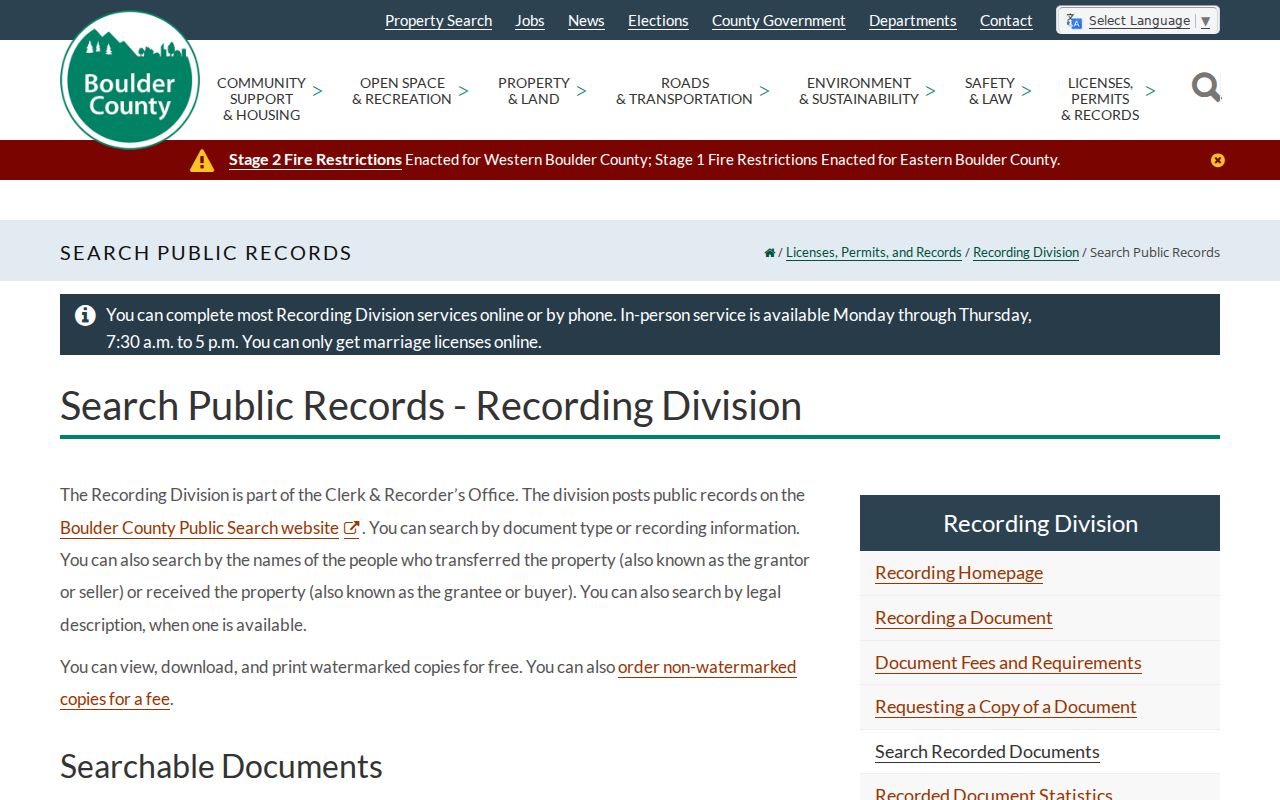
The county's own page draws the line clearly. Judicial case files sit with the state court clerk, not the elected County Clerk & Recorder.