
Searching Boulder County Civil Dockets
Start with the free Boulder-filtered Colorado Judicial Docket Search. Use it for any scheduled civil proceeding. Pick Boulder County, then the Boulder or Longmont courthouse if you know it. Set the court level to County, District, or Both. The tool needs a date plus at least one more filter before it will run. Your best key is a complete case number. It carries the year, class, and sequence in one string. Searching by party works too, with a first and last name or a business name. Just remember the result is a settings list, not the full Boulder County civil docket.
A careful docket search follows five steps:
- Identify whether District Court, County Court, or Water Court is likely to hold the matter.
- Set the courthouse, court type, and date range, then add a case or party filter.
- Use the four-digit year, civil class, and sequence when a case number is available.
- Read the result for date, time, duration, hearing type, location, courtroom, and appearance mode.
- Request the ROA, judgment, or named filing from the clerk when the calendar cannot answer the question.
You will see results 20 per page, and you can print or export them. Opening the pleadings is another matter. A blank appearance field grants no remote-attendance right. Check the newest notice or minute order first, then call the assigned division or the clerk if a setting still seems unclear.
Boulder County Civil Case Classes
Every Colorado case number packs in the filing year, a class code, and a sequence. A typical District Court civil number reads 2026CV123. Copy the format exactly as the portal shows it. Adding hyphens on your own will break the lookup. The class tells you which procedural track the case follows. It says nothing about who won, what a judgment is worth, or whether any order is final.
- CV
- District Court civil case.
- C
- County Court civil claim within that court’s limited jurisdiction.
- S
- Small-claims procedure in County Court.
- DR
- Domestic-relations matter.
- PR
- Probate matter, which may include protected documents.
- CW
- Designated water case handled through Water Division 1.
Class codes exist to keep unlike Boulder County civil dockets from blending together. A search on a common name can still return several settings, so match the class, sequence, party role, and courthouse before trusting a hit. The portal also lets you filter by District, County, or Both.
Inside a Boulder County Civil Docket
Think of the Register of Action, or ROA, as the case's chronological index. A Boulder County civil docket might open with a complaint or petition, then move through service or return, an answer, motions, minute orders, conferences, hearings, trial, judgment, enforcement, satisfaction, and appeal. The real order depends on the case. One caution matters here. A filed motion is only a request for relief. It is not a ruling by the judge.
| Case identity | Year, class, sequence, court, caption, and status. |
|---|---|
| Parties | Plaintiff or petitioner and defendant or respondent, with counsel when recorded. |
| Filings | Dated complaints, petitions, answers, motions, and other indexed documents. |
| Minute orders | Recorded court rulings or directions, sometimes without a separate long order. |
| Settings | Conference, hearing, court trial, jury trial, or other planned event. |
| Outcome | Judgment, dismissal, settlement entry, satisfaction, enforcement, or appeal activity. |
The free calendar gives you settings and nothing more. Full captions, all claims, financial terms, the chronological ROA, and document images stay off the screen. When you need exact wording or a court-authenticated copy, request the actual order.
Boulder County Civil Court Boundary
County Court takes civil claims through $25,000. Above that limit, the matter belongs to District Court. Small claims runs as a County Court procedure rather than a separate constitutional court. Domestic relations and probate travel District Court tracks. Water Division 1 handles the designated CW cases. Municipal courts, as a rule, are not where private civil complaints get filed.
| Court | Boulder County civil docket coverage | Useful classes |
|---|---|---|
| District Court | Civil above the County Court limit and assigned general civil work | CV |
| County Court | Civil claims through $25,000 and small claims | C, S |
| District specialty tracks | Domestic relations, probate, and mental-health matters | DR, PR |
| Water Division 1 | Designated water matters | CW |
Pick the wrong layer and a valid setting can vanish from view. If nothing comes back, run Both court types, confirm the class, widen the date range, and try both Boulder and Longmont. Then call the clerk with the party name and filing year in hand.
Civil Case Types on the Docket
Boulder County civil dockets hold several distinct record types. General civil matters can involve contract, tort, and property disputes. County Court carries the limited civil claims plus small claims. Domestic-relations cases run under DR. Probate files use PR. Some papers inside a probate file carry access restrictions. A CW class marks water-court territory. Protection-order proceedings may also surface through the County Court system.
The first filing's name shifts with the case type. A complaint typically opens a general civil claim. A petition more often begins a domestic or probate matter. From there the entries pile up. Expect an answer, return of service, motion, minute order, status conference, trial, judgment, or satisfaction. Read the caption and the class together before drawing any conclusion from a single event.
Note: A docket entry only indexes case activity. The filed pleading or order supplies the exact language of the court record.
Boulder County Civil Division Map
For 2026 to 2027, the assignment rotation puts trailing civil work in District Divisions 2 and 3. Domestic-relations matters rotate through Divisions 1 and 14. Division 5 carries probate and mental-health assignments. On the County side, divisions 7 through 11 rotate through County Court business, civil claims included. Judges rotate roughly every two years, so a name saved from an older docket is no fixed guide to who holds the case now.
The official judges and staff directory lists current division contacts and assignments. A quick call to the division can confirm local procedure or a setting. The Boulder County Combined Court clerk remains the holder of the official ROA, filed orders, and certified copies. If a case moves up on appeal, the trial docket may show the notice and record transmission, while the appeal itself gets a new number.
Civil Docket Settings and Hearings
Boulder County calendar entries carry labels such as Court Trial, Jury Trial, Hearing, Status Conference, Initial Conference Appearance, Permanent Restraining Order Hearing, Return Date on Summons, Hearing on Guardianship, and Motion to Modify Hearing. A single result can list the date, start time, estimated duration, party name, case number, hearing type, courthouse, appearance mode, and courtroom. It may not show a judge or link into the civil ROA.
A reset means the event moved. A continuance is court permission to postpone it. Neither a phone call nor an old line on the calendar proves a continuance was granted, so check the future setting and the newest notice or minute order. Return dates follow a local pattern in this county. Boulder sets them Wednesdays at 1:30 p.m., while Longmont uses Fridays at 1:30 p.m., except holidays and the Friday after Thanksgiving. A pattern is only a pattern. The notice in your specific case governs.
The appearance field can read IN PERSON, VIRTUAL, or stay blank. Blank does not mean remote. Use the local virtual-courtroom directory only when the docket result or the court itself authorizes it, and call the current division if those two sources disagree.
Boulder County Probate Settings
Probate and guardianship entries show why a civil calendar is narrower than a case file. One Boulder setting label reads Hearing on Guardianship. It tells you what proceeding is planned and where it sits on the docket. It does not expose every petition, report, protected fact, or order. The PR class points the docket search toward probate. The Combined Court clerk controls access to what was actually filed.
Probate is not fully closed. Even so, some papers need more. Certain documents and protected facts can require ID or proof that you are authorized to see them. The official record request form offers probate choices. They cover letters, wills, trusts, applications, petitions, closing documents, and claims. It may also ask for a date of death. If the public calendar shows nothing, use Records/Research. Give the case number, filing year, party names, and the exact document you want. Do not assume the Boulder County civil docket does not exist.
Boulder County Judgment Records
Three records get confused here. A judgment entry is the court's own decision on the claim. A transcript of judgment is a clerk-issued judgment record. It costs $25. That record is not a word-for-word account of any hearing. A certificate of satisfaction shows the judgment has been satisfied and costs $20. Certified or exemplified copies are authenticated by the clerk at a listed $20 per document. Copying charges apply where that applies.
The state Record/Document Request Form covers a wide range. It lists Order for Judgment, Transcript of Judgment, Satisfaction of Judgment, Protection Order, the civil ROA, and common family or probate documents. You can submit the form online, email 20recordsrequest@judicial.state.co.us, call 720-664-1468, or mail P.O. Box 4249, Boulder, CO 80306. In person, the clerk sits at 1777 Sixth Street in Boulder or 1035 Kimbark Street in Longmont. A $5 name search may apply. Actual-cost off-site retrieval and research or redaction fees may apply under the published schedule.
State-listed commercial systems can feed you real-time civil ROA data. They hand over no official records or copies of filed documents. Colorado Courts E-Filing serves the people who file, not the public docket. No official Boulder page promises a lobby terminal. Call ahead before you go. Older files may sit off site and need retrieval.
Civil Docket Access Rules
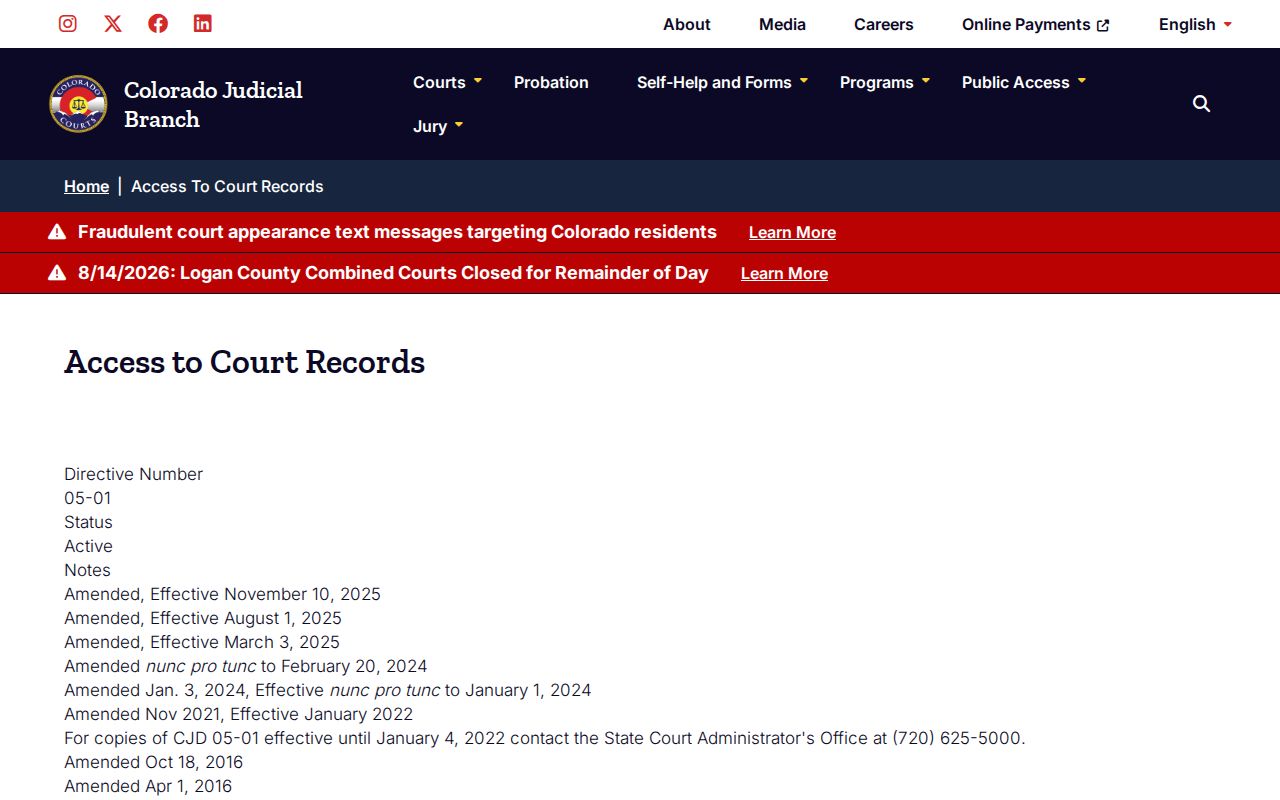
Most ordinary Boulder County civil docket information is open. Access has limits. CJD 05-01 governs public access, remote access, exclusions, vendor service, and correction. Court rules and case-specific orders can seal a file. They can also strip protected details from the public version. Juvenile and adoption material faces stronger limits. A domestic or probate docket can stay public while one document inside it remains confidential.
The Judicial Branch publishes CJD 05-01 and its court-access material. That state rule controls Boulder County civil docket records. Read it there before assuming any entry is open or closed.
This line matters in practice. A civil setting can appear on the public docket while the filing behind it is sealed, redacted, or limited to an authorized person.
Key access rules:
CJD 05-01, Public Access to Court Records controls access to Colorado Judicial Branch case records.
Colorado Supreme Court Rules, Chapter 38 supplies standards for Judicial Branch information and administrative records.
Colorado Open Records Act covers qualifying government records, but judicial case files follow court rules and the clerk request route.
Boulder County's ordinary CORA queue cannot replace a judicial case-file request. Start with the free docket calendar. The clerk supplies the official ROA and documents, the direct division answers procedure, and the correct municipal custodian only matters when the case truly belongs to a city court. Confirm anything important with the originating court.